
Executive, Strategic Executor, or Executor: Where Do You Land?

Does Your Senior Title Match Your Real Scope?

A senior title can tell people where you sit on an organizational chart. It does not always tell them how you operate.
A director in one organization may set priorities, control a budget, advise senior leadership, and make decisions that affect the entire organization. Another director may coordinate projects, prepare reports, supervise daily operations, and implement decisions made several levels above.
Both may be experienced. Both may be valuable. Both may carry significant responsibility.
They are not necessarily operating at the same level.
This distinction matters when you are preparing for advancement, considering an executive role, or trying to explain your experience on a résumé or LinkedIn profile. Employers do not evaluate senior candidates on title alone. They look for evidence of what you owned, what you influenced, which decisions you made, and what changed because of your leadership.
The question is not simply “How senior is my title?”
The more useful question is:
Do I set the direction, translate the direction into action, or deliver the work within a direction someone else has established?
Why Doesn’t a Senior Title Automatically Make Someone an Executive?
Titles are not standardized across organizations.
A vice president in a small company may perform work similar to that of a manager in a larger organization. A program manager may influence organizational policy without holding a formal leadership title. A department director may be responsible for a large volume of work but have little authority over strategy, budgets, staffing, or priorities.
This is why career positioning requires more than placing an impressive title at the top of a résumé.
Your operating level is revealed through your:
Decision-making authority
Scope of responsibility
Accountability for outcomes
Influence across teams or departments
Control over people, resources, policy, or budgets
Role in setting or interpreting organizational priorities
A title may create an initial impression. Your examples determine whether that impression holds.
What does a title actually tell us?
A title may suggest your place in the hierarchy, your functional area, and the organization’s expectations when you were hired. It does not necessarily show how your responsibilities changed, whether you absorbed work beyond the original role, or how much authority you were given.
Some professionals have titles that are more senior than their actual scope. Others are already performing strategic or leadership work without the title, compensation, or recognition that should accompany it.
Understanding that gap is essential before you decide how to position yourself or what role to pursue next.
What Is the Difference Between an Executive, a Strategic Executor, and an Executor?
These are not rankings of intelligence, ambition, or professional worth. They describe different ways of contributing to an organization.
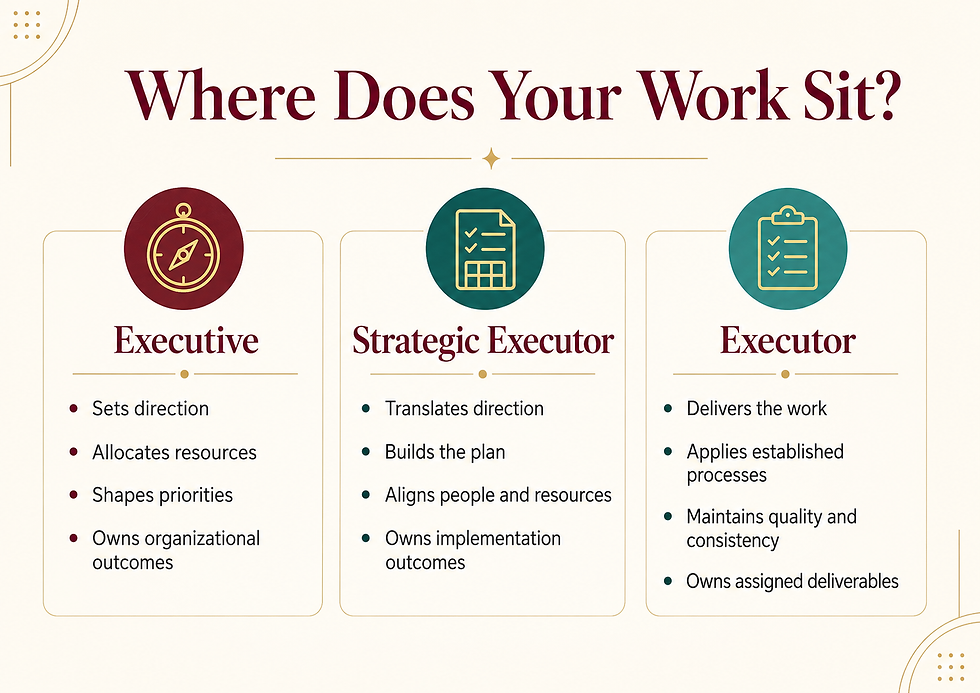
For this discussion, strategic executor refers to the professional who operates between organizational direction and day-to-day delivery. It is a practical career-positioning framework, not a formal occupational classification.
What does an executive own and influence?
An executive helps decide where the organization is going.
Executives establish priorities, allocate resources, evaluate risk, shape policy, influence major stakeholders, and make decisions with broad organizational consequences. They may oversee operations, but their value is not defined only by how well the work is completed.
They are also accountable for deciding which work matters.
Executives commonly address questions such as:
What should we prioritize?
Where should we invest?
What must change?
What risks require leadership attention?
How should we respond to market, workforce, customer, or regulatory changes?
What outcomes will define success?
Their work may include setting a multiyear direction, approving budgets, restructuring functions, building external partnerships, advising a board, or determining how resources should be distributed across competing priorities.
An executive does not merely participate in important conversations. The executive has meaningful influence over the decisions that emerge from them.
What makes someone a strategic executor?
The strategic executor turns direction into reality.
This professional may not determine the organization’s highest-level priorities, but they interpret those priorities and build the route from intention to outcome. They identify what must happen, who must be involved, where resistance may appear, and which systems or processes need to change.
Strategic executors often:
Translate broad goals into operational plans
Lead cross-functional initiatives
Design programs, processes, or implementation systems
Anticipate barriers and recommend solutions
Coordinate people, information, technology, and resources
Advise leaders on what implementation will require
Adjust plans when conditions change
Own program, departmental, or initiative-level outcomes
This role requires judgment, influence, and organizational awareness. It is more than following instructions, even when the original direction comes from someone else.
The need for this kind of contribution is significant. Project Management Institute research found that 35% of executives identified a disconnect between planning and execution as their leading barrier to organizational reinvention. The same global research found that only half of projects fully delivered the value expected of them.
Organizations rarely struggle because no one can create a plan. They often struggle because the plan must be translated into coordinated, sustainable action.
The executive may identify the destination. The strategic executor builds and manages the route.
What does an executor contribute?
The executor delivers the work.
Executors apply established plans, procedures, and standards. They coordinate activities, manage assignments, maintain quality, solve immediate problems, and make sure responsibilities are completed accurately and on time.
An executor may:
Carry out established processes
Coordinate schedules and deliverables
Track progress and report results
Maintain records or systems
Support programs and projects
Respond to operational problems
Ensure compliance with standards
Complete specialized or technical work
Execution is not unimportant work. Plans do not produce outcomes by themselves.
A strong executor may be the person everyone trusts when something must be done correctly, consistently, and without unnecessary drama. That reliability creates real organizational value.
The limitation is not the importance of the work. It is the level of authority attached to it. An executor typically works within a direction, structure, or set of priorities established by someone else.
How Can You Tell Where You Currently Land?
Most professionals perform some combination of executive, strategic, and execution-focused work. Your goal is not to force every responsibility into one category.
Your goal is to identify your dominant operating level.
Use the following questions to examine your role.
Who sets your priorities?
Do you determine what the organization or department should pursue?
Do you receive a broad priority and decide how it should be achieved?
Or are you assigned specific responsibilities within an established plan?
What happens when the goal is unclear?
An executive may define or revise the goal.
A strategic executor may clarify the goal, recommend an approach, and create an implementation plan.
An executor may request additional direction before proceeding.
How much authority do you have to change the plan?
Can you redirect resources, revise priorities, approve changes, or stop an initiative?
Can you recommend changes and adjust implementation within agreed-upon limits?
Or must you escalate most decisions to someone else?
What are you accountable for?
Are you accountable for organizational direction and enterprise results?
Are you accountable for a program, department, transformation, or cross-functional outcome?
Or are you accountable for completing assigned deliverables and maintaining expected standards?
What do senior leaders rely on you to provide?
Do they rely on your judgment when making consequential decisions?
Do they rely on you to interpret their decisions and make implementation work?
Or do they rely on you for accurate information, dependable support, and timely completion?
How far does your influence extend?
Does your influence affect the entire organization, a business unit, or external stakeholders?
Does it extend across departments and functions?
Or is it concentrated within your immediate team, assignment, or area of expertise?
Career Scope Check
Read each row and identify the statement that most closely reflects your current work.
Situation | Executive | Strategic | Executor |
Priorities | I help establish them. | I translate them into plans. | I work within them. |
Decisions | I make or approve consequential decisions. | I recommend and make implementation decisions. | I make decisions within assigned responsibilities. |
Accountability | I own enterprise or organizational outcomes. | I own program, initiative, or cross-functional outcomes. | I own assigned work and deliverables. |
Resources | I allocate or approve them. | I coordinate and optimize them. | I use them within established limits. |
Change | I determine what must change. | I determine how the change will be implemented. | I adapt my work to the change. |
Leadership access | I advise peers, boards, or senior decision-makers. | I provide recommendations and implementation insight. | I provide information, support, or status updates. |
Your answers may not fall neatly into one column. That is normal.
Look for the column that reflects most of your work, especially the work for which you are evaluated and held accountable.
Can One Person Operate at All Three Levels?
Yes. In fact, many effective senior professionals move among all three.
An executive may spend part of the day reviewing operational details. A strategic executor may set direction within one program while implementing priorities established by the executive team. An executor may make independent decisions within a technical area while following a broader organizational plan.
The distinction is not about whether you ever perform a certain kind of task. It is about where your role is centered.
This is especially important as organizations place greater value on speed and adaptability. Deloitte’s 2026 Global Human Capital Trends research found that 67% of leaders expect speed and agility to be their primary competitive advantage during the next three years. Eighty-eight percent said accelerating how people, skills, and resources are orchestrated is extremely or very important, yet only 7% said their organizations were making great progress toward that goal.
Modern leadership increasingly requires movement between direction, interpretation, and delivery. Even so, employers will still want to know which level best represents the value you are prepared to provide.
What Happens When Your Title and Scope Do Not Match?
A mismatch between title and scope can create confusion inside an organization and in the external job market.
What if your title is more senior than your authority?
You may hold a director, vice president, or department-head title while having limited authority over budgets, staffing, policy, organizational priorities, or long-term direction.
This does not mean your work lacks value. It means the title may lead prospective employers to expect examples of executive decision-making that your role did not allow you to develop.
The gap often becomes visible during interviews when you are asked:
Tell me about a strategy you established.
Describe a consequential decision you made.
How have you influenced executive leadership?
What resources were you responsible for allocating?
What organizational risks did you identify and address?
If your examples focus primarily on implementation, coordination, and delivery, your title may be senior while your experience is closer to strategic execution or execution.
That is not a reason to inflate your story. It is information you can use to identify the experience you need next.
What if your responsibilities are more senior than your title?
The reverse happens just as often.
You may hold a manager, coordinator, specialist, or program title while advising leaders, designing systems, influencing policy, leading cross-functional work, or carrying responsibility that extends far beyond your formal position.
This can occur in small organizations, nonprofits, healthcare, education, government, family-owned businesses, and workplaces where capable employees gradually absorb additional responsibilities without formal reclassification.
For some immigrant professionals, the mismatch is also connected to how we learned to prove our value. You may have been taught to work hard, respect hierarchy, avoid appearing boastful, and trust that good work will eventually be recognized.
You may also have entered the U.S. workforce focused on stability, credential acceptance, sponsorship, income, or the opportunity to establish yourself. That can make it easier to accept expanding responsibility without pausing to ask whether your title, compensation, and professional positioning have expanded with it.
Your dedication is not the problem. The problem arises when the market cannot see the level at which you have learned to operate.
You should not invent a more senior title. You should make the true scope of your work impossible to miss.
Why Does This Matter for Your Résumé and LinkedIn Profile?
Your professional documents should show the level at which you operate, not simply list everything you have done.
A common résumé problem occurs when senior professionals describe themselves almost entirely through tasks. Their bullets may say that they attended meetings, prepared reports, supervised staff, coordinated projects, and communicated with stakeholders.
Those activities may all be accurate. They do not show the judgment, authority, influence, or organizational outcomes behind the work.
Strategic executors often undersell themselves in a different way. They describe what they implemented but leave out how they interpreted an unclear mandate, aligned competing stakeholders, redesigned a process, resolved resistance, or advised leaders.
Executors may create the opposite problem by using inflated language that suggests authority they did not hold. Words such as “transformed,” “spearheaded,” and “directed strategy” cannot substitute for evidence of actual ownership.
Strong positioning is not about making your work sound more senior.
It is about communicating its full value without misrepresenting its scope.
How would the same initiative appear at each level?
Consider an organization introducing a new employee-onboarding model.
Executor
Coordinated onboarding sessions, maintained employee records, tracked completion, and responded to new-hire questions
.Strategic executor
Designed and led the cross-functional rollout of a standardized onboarding model, aligning HR, operations, and department leaders to improve consistency and resolve implementation gaps.
Executive
Established an organization-wide workforce integration priority and authorized a standardized onboarding model to strengthen retention, performance, and employee experience.
The initiative is the same. The contribution is different.
Your résumé, LinkedIn profile, and interview examples should make that difference clear.
What Does Your Next Career Move Require?
Once you understand where you currently land, you can make a more informed decision about where you want to go.
How does an executor develop strategic-execution experience?
Look for opportunities to move beyond completing the work and begin shaping how it is done.
That may include:
Leading a project or pilot
Improving a process
Developing an implementation plan
Coordinating work across departments
Identifying a recurring problem and recommending a solution
Tracking outcomes rather than activities alone
Presenting findings or recommendations to leadership
Taking ownership of a defined program result
The shift begins when you are trusted not only to deliver, but also to interpret, recommend, and improve.
How does a strategic executor prepare for executive leadership?
You may need greater exposure to:
Organizational planning
Budget development and resource allocation
Governance and policy
Enterprise risk
Board or executive-team communication
External partnerships
Workforce and succession decisions
Long-term organizational outcomes
You also need examples that demonstrate influence, judgment, and accountability beyond successful implementation.
The World Economic Forum reported that leadership and social influence showed a 22-percentage-point increase in the share of employers identifying them as core skills compared with its 2023 research. This suggests that advancement will require more than technical competence or dependable execution. Professionals must also demonstrate the ability to influence people, decisions, and outcomes.
What if you do not want to become an executive?
That is a valid career decision.
Not everyone wants to carry enterprise risk, navigate executive politics, manage large teams, or move farther away from the work they enjoy. Some professionals are most effective when designing programs, solving operational problems, leading implementation, serving clients, or applying deep technical expertise.
The goal is not to make “executive” the correct answer.
The goal is alignment between:
How you prefer to contribute
What authority you want
What outcomes you want to own
How close you want to remain to delivery
What kind of accountability you are prepared to carry
How you present yourself to the market
Where Do You Land, and Where Do You Want to Go Next?
An executive sets direction.
A strategic executor translates direction into systems, plans, and outcomes.
An executor delivers the work within an established direction.
Each creates value. Each requires skill. Each deserves accurate positioning.
Before you pursue another senior title, revise your résumé, or describe yourself as an executive leader, ask:
What decisions am I authorized to make?
What outcomes do I personally own?
What do leaders rely on me to provide?
Where does my influence begin and end?
Does my professional story reflect my true scope?
What level of responsibility does my next move require?
Your answers may explain why your current positioning feels unclear, why interviews are not progressing as expected, or why your title no longer reflects the contribution you are already making.
You may not need a more impressive label.
You may need greater clarity about the work you do, the value you create, and the level at which you are ready to lead.
Let’s Clarify Your Next Move
A title alone cannot tell your full professional story. Your scope, authority, impact, and direction must also be clear.
A consultation can help you examine the level at which you currently operate, identify gaps between your title and responsibilities, and determine how to position your experience for the opportunities you want next.
APA REFERENCES
Deloitte. (2026, March 4). The orchestration advantage. Deloitte Insights.
Project Management Institute. (2025, December 11). New PMI research reveals strategy-execution gap is undermining transformation and how to close it.
World Economic Forum. (2025, January 7). Skills outlook: The Future of Jobs Report 2025.

Comments